Overview
Key Highlights
Tools & Methods
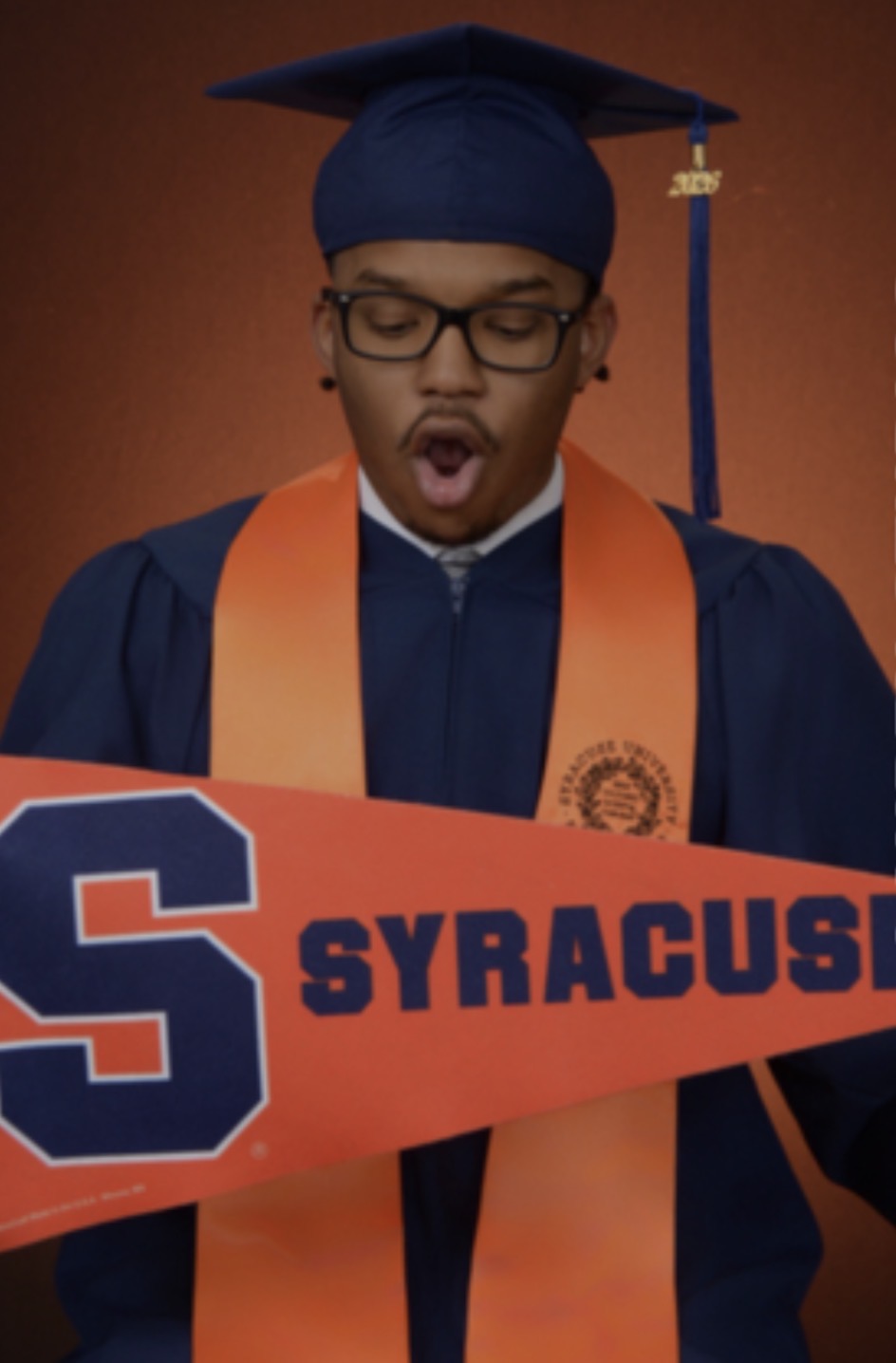
B.S. Mechanical Engineering — Minor in Computer Science
U.S. Citizen · Expected May 2026
First-generation college student and aspiring engineer passionate about integrating software and mechanical engineering to create innovative, real-world solutions — from CFD radome optimization and ANSYS simulations to AI model evaluation and autonomous vehicle control.
College of Engineering & Computer Science
I'm a first-generation college student pursuing a B.S. in Mechanical Engineering with a Minor in Computer Science at Syracuse University. I'm highly motivated to learn and adapt quickly, and passionate about integrating software and mechanical engineering to solve real-world problems that drive impact and efficiency.
My experience spans AI model evaluation at Handshake, CFD-driven radome optimization at JMA Wireless, energy auditing at the Industrial Training Assessment Center, soft-matter computational research at the SYFY Lab — while also mentoring incoming ECS Students as a Catalyst mentor and towards NSBE Jr. students.
I thrive at the intersection of physical systems and computation: building MATLAB pipelines for wind-tunnel data, training neural networks for autonomous vehicle control, or modeling soft polymer mechanics under deformation.
A rigorous curriculum blending mechanical systems, computation, and hands-on design at Syracuse University's College of Engineering & Computer Science.
B.S. Mechanical Engineering · Minor in Computer Science · Expected May 2026
Diverse engineering, AI, research, and technical roles applying classroom knowledge to real industry challenges.


Hands-on work spanning autonomous AI, mechanical CAD design, fluid mechanics, signal processing, structural analysis, energy systems, and systems programming.
Collected and engineered steering-angle and vehicle-dynamics data in Udacity's simulator using Python to build a supervised AI dataset. Preprocessed and augmented image data (cropping, normalization, flipping, balancing), then trained a CNN based on NVIDIA's end-to-end architecture in TensorFlow to autonomously control a simulated vehicle.
Designed and analyzed a two-stage reverted speed reducer in SolidWorks. Performed shaft stress and fatigue checks using the Distortion Energy Theorem (DET), optimized gear geometry and face width for durability with safety factors ≥ 2, and documented all design calculations using MATLAB.
Reverse-engineered and modeled a complete salad spinner in SolidWorks by disassembling, measuring, and replicating all 18 individual parts. Produced a 12-sheet drawing package with orthographic views, exploded assemblies, section cuts, GD&T callouts, and a full Bill of Materials.
Designed and assembled a functional air engine in SolidWorks with precise multi-part fits. Applied GD&T standards and created a complete 9-sheet engineering drawing package covering all 15 components including exploded views and a full Bill of Materials.
Derived equations of motion with Lagrange's method (wheel–suspension mass–spring–damper including rotation) using MATLAB Symbolic Math. Implemented forward-Euler simulations and extended to a 2-DOF vehicle model (translation + pitch) for numerical vs. analytical comparison.
Built a full symbolic and numerical MATLAB simulation of projectile motion for a 0.45 kg ball launched at 30° over 24 m. Solved for flight time (2.30 s) and initial velocity (22.60 m/s) symbolically, then extended the model to include linear air resistance for comparison.
Built a LabVIEW and MATLAB workflow to acquire a 750 Hz sine at 25 kHz (12-bit). Demonstrated digitization errors, quantization effects, ADC clipping harmonics via FFT, and applied FFT to square and sawtooth waves. Used low-pass/high-pass filters to mitigate aliasing.
Calibrated a closed-loop wind tunnel, measured vortex shedding via FFT (97.5 Hz & 159.2 Hz), computed Strouhal/Reynolds numbers, mapped cylinder wake pressure, and characterized airfoil performance (clean vs. dirty) at 30/45 Hz.
Applied three-point bending to a simply supported beam using the Lloyd LS5 testing machine. Measured load, deflection, and strain across two span configurations and compared experimental results against Euler-Bernoulli beam theory.
Measured and compared convective heat transfer rates from a flat aluminum plate versus a finned heat sink under forced airflow (0–2.7 m/s). Calculated heat transfer coefficients, validated fin temperature distributions, and determined fin efficiency and Biot number.
Analyzed air-side performance of a vapor-compression air-conditioning system (ET506 rig) using psychrometric analysis. Determined cooling capacity, sensible and latent heat transfer, SHF, and moisture removal rate under transient and steady-state conditions.
Collaborated with NSBE Jr. students to reverse-engineer and rebuild a broken RC car into a functional Ten80-NSBE STEM League racer. Diagnosed and repaired mechanical and electronic subsystems, restored performance to competition specs, and mentored students on engineering fundamentals.
Sentinel-controlled loop (sentinel = −1) accepting arbitrary quiz scores, computing count, floating-point average (one decimal), and letter grade (A–F). Handles zero-score edge case with no division by zero.
Coin-accumulator accepting quarters (25¢), dimes (10¢), nickels (5¢) via sentinel loop. Includes three-level top-down pseudocode refinement as comments and checks if the user has enough for a $1.00 item.
Analyzes the classic C pitfall: 7/2 as int truncates to 3.00, while a (double) cast gives 3.50 — demonstrating why implicit truncation surprises new programmers and how casting resolves it.
Counter-controlled loop processing 8 students × 3 exam scores. Computes per-student average and letter grade, then class average and A–F counts. Includes pseudocode and a logic-error fix (n < 20 → n <= 20).
Full modular C program with do-while input validation, readPrices, calcTotal, applyDiscount (15%), findMaxIndex, countAboveAvg, and printSummary. Also a 40-question fill-in-the-blank exam.
Analyzes 10 quiz scores via fillArray, calcAverage, findMax, findMin. Uses #define SIZE 10 throughout, applies const on non-modifying parameters, and initializes min/max to the first element.
Contact list using a typedef struct with name, phone, and age. Implements fillContacts (fgets + buffer flush), printContacts (formatted table), and findOldest returning a struct by value.
Five-part pointer deep-dive: address inspection, restock and applyBulkDiscount in-place, const double * read-only catalog, sizeof storage audit, and end-of-day sales using pure pointer arithmetic *(sPtr + i) — no [].
Full Tic-Tac-Toe in Racket supporting arbitrary N×N boards. Implements board?, next-move, valid-move?, make-move, winner?, and a bonus choose-next-move AI via the MiniMax algorithm. Playable via a GUI runner with verbose and AI modes.
A broad toolkit developed across engineering design, simulation, programming, and hands-on fabrication and testing.